
Known for controversy, Pearl Jam just wants to be liked
BY HOWARD COHEN
hcohen@herald.com
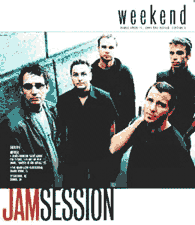
Joining a growing list of pop stars who have made antiwar statements -- Dixie Chicks, Chrissie Hynde, Sheryl Crow, Lenny Kravitz and the Beastie Boys, among them -- Pearl Jam incensed some fans at a Denver concert last week when lead singer Eddie Vedder took a mask of President Bush and impaled it on a microphone stand.
This, from a group whose new song Bushleaguer lyrically impales the president with lines like: ``He's not a leader, he's a Texas leaguer / . . . Drilling for fear, makes the job simple / Born on third, thinks he got a triple.''
Several concertgoers booed and shouted Vedder down as he told the crowd he was against the war and Bush. The mask incident occurred during the encore of the band's opening show of its U.S. tour, and it's something he had done in Australia and Japan with no outcry.
In a statement issued by the band through its label, Epic, Pearl Jam downplayed the reported incident.
``There were close to 12,000 people at the April 1st Denver show. It's possible two dozen left during the encore, but it was not noticeable amongst the 11,976 who were applauding and enjoying the evening's music. It just made a better headline to report otherwise. Ed's talk from the stage centered on the importance of freedom of speech and the importance of supporting our soldiers, as well as an expression of sadness over the public being made to feel as though the two sentiments can't occur simultaneously.''
Ironically, a day before the Denver concert, founding guitarist Stone Gossard commented by phone on Vedder's anti-Bush antics overseas and suggested that calmer measures might be prudent. ''I think you need to take in a real big perspective when you talk about the war publicly,'' he says. ``It's important for everyone to speak their mind but, at the same time, I think there has got to be a certain delicacy used.
''The war is happening. There's nothing anyone can do at this point to stop that unless there's a nationwide naked sit-in,'' Gossard says -- adding a deadpan, ``which is not a bad idea.''
BEING ACCESSIBLE
For all of its missteps, Pearl Jam -- playing the Sound Advice Amphitheatre (formerly Coral Sky) in West Palm Beach tonight -- wants to be liked these days. Press interviews, once avoided, are not only granted but solicited by the group and its major label.
''We should be selling more records,'' Gossard says, his tone more yearning than boastful. The group's most recent albums, the current Riot Act and 2000's Binaural, have barely sold a half-million copies apiece. By comparison, the group's second album, Vs., sold about 900,000 copies in a single week in 1993.
After a decade spent shunning the star-making machinery -- no video clips; that widely-reported, but futile, fight against Ticketmaster; the battle against commercialism (in 1994 the band once refused to go on stage at downtown Miami's then-AT&T Amphitheatre until the AT&T banner above the stage was covered less than an hour before show time) -- the band is loosening up a bit.
``We play so many sheds [outdoor amphithe-
aters] that have built-in advertising in them now
. . . we're a lot less uptight about that stuff now,'' Gossard says. ``It's impossible to keep control of it. We're much more realistic about what we can and can't control.
``What we can control is how we make records and how we tour and how much we charge for tickets. Those kind of details are the bigger things in terms of setting an example.''
Being fan-friendly is one way Pearl Jam hopes to survive into its second decade. Tickets for its current tour are around $40, remarkably low in these days of $200 and $300 concert tickets.
Pearl Jam also released to retail official bootleg recordings of all 72 concerts on its 2000 tour. This time the band takes advantage of technology by making approved bootlegs available immediately on the group's website ( pearljam.com). For $15 plus a $3 shipping charge, fans receive a link to download an unmastered MP3 file the day after the concert and a fully mastered double-CD ships to your home a week later. That means if you catch Pearl Jam's concert tonight, you can relive the memory this weekend.
TESTING PATIENCE
And yet, for all of this, Pearl Jam tests its fans' patience.
The group's post-Vitalogy (1994) albums have largely eschewed concise songwriting or, as on Riot Act, merely reheated old ideas to lesser effect.
The band's concert set lists also fluctuate widely with more album tracks featured than singles. This thrills some fans -- and the band feels fresh night after night -- but it can lose the casual listener who wants to hear the hits that made Pearl Jam the biggest American rock group for a few years, back when.
''It's cool because sometimes songs you wouldn't expect, that weren't singles, could have an impact,'' Gossard says. ``Otherwise you might not discover that song if you didn't take a chance on it. It's fun to go back and remember how to play things.''
Fair enough. But then the war came, Vedder acted out, and the band found itself on the receiving end of another black eye.
Through all of that, Pearl Jam remains the sole survivor of the early '90s Seattle grunge movement. Gone: Nirvana, Soundgarden, Alice in Chains, Candlebox.
''All of us are now in our mid- to late-30s and we feel blessed and fortunate to be in a band where people still care about us,'' Gossard, 36, says. ``We are better friends, and we've gone through a lot. We have a sense of family.
``We're average guys who can pick up a guitar and noodle around in the key of E-minor, and it's cool to know you can still make music from a place of naveté, and we all try to approach that from a simplistic point of view.''